
We Baby Boomers grew up in a time of contradictions: on the one hand we were told by friendly turtles that we’d be safe from a nuclear explosion if we ducked ‘n covered under our school desks; on the other, we were constantly being warned that some activity or another was likely “to put an eye out.”
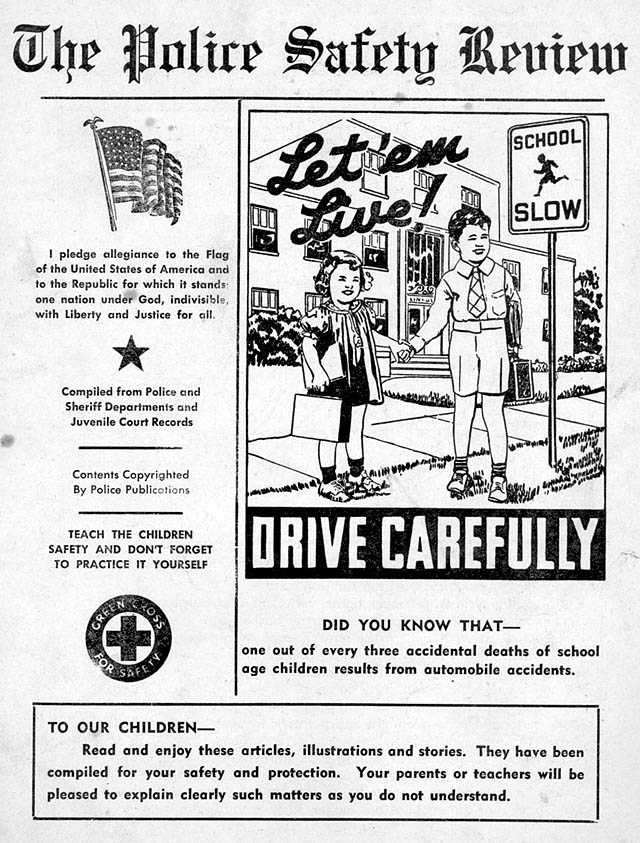
While rummaging around in the time capsule otherwise known as my Mother’s attic, I came across a 24-page publication, The Police Safety Review, which had been distributed by the Cape Girardeau Police Department. There’s a 1954 Rube Goldberg cartoon – yes, THAT Rube Goldberg – in it, so I’m going to guess it was published in the mid-to-late 1950s.
Police Safety Review Cover
Safety bottom line
Do something illegal or careless and you’re likely to be
- Killed
- Injured severely
- Scarred for life
- Arrested
- Have your bike taken away
- Have a mark on your permanent record
- All of the above
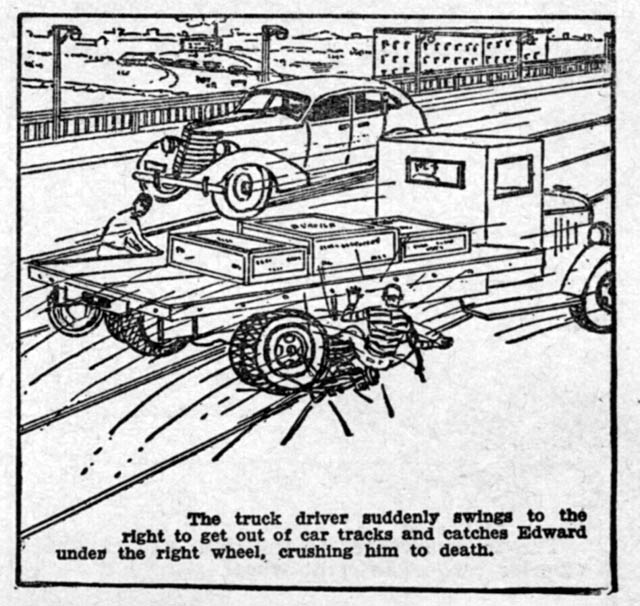
Hold on to truck, be crushed to death
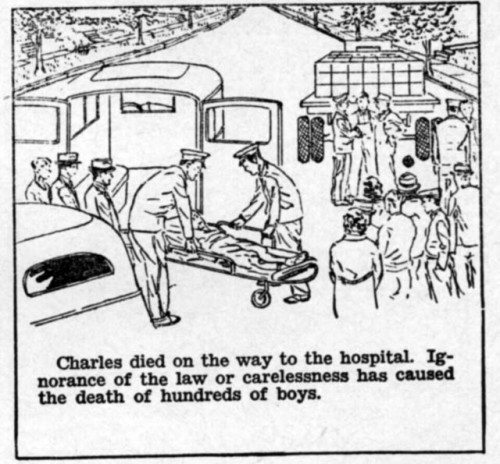
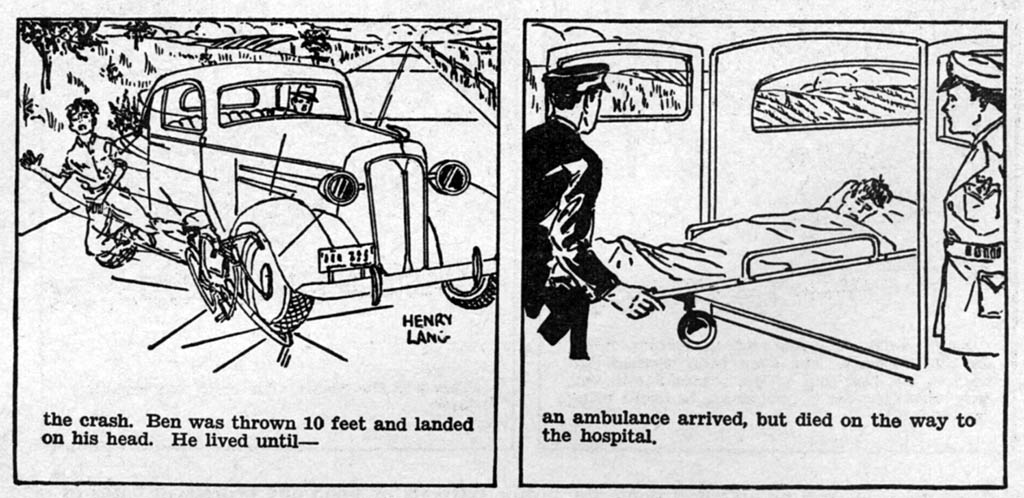
Ignorance of the law: die on way to hospital
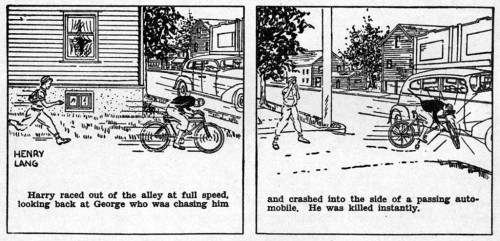
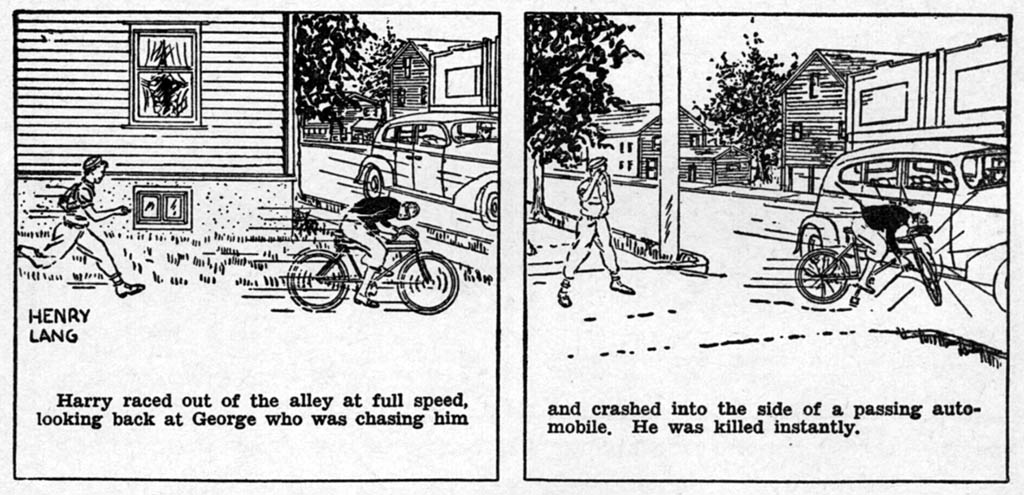
Racing without looking: killed instantly
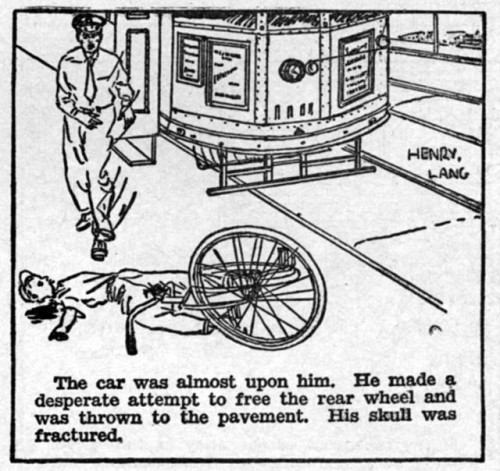
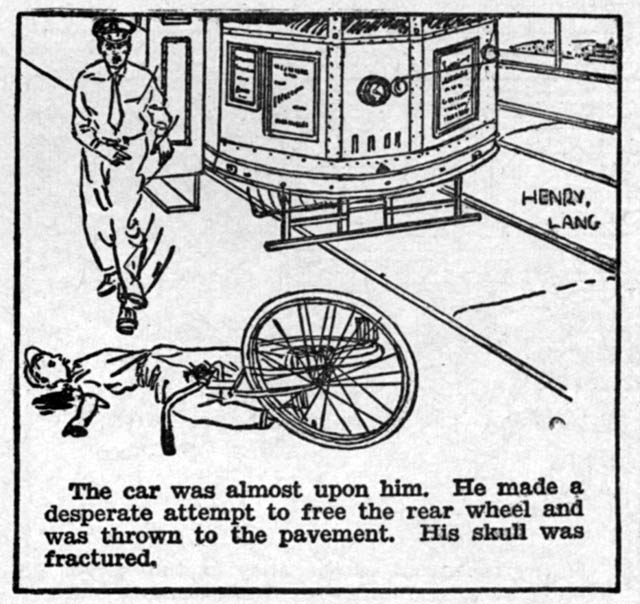
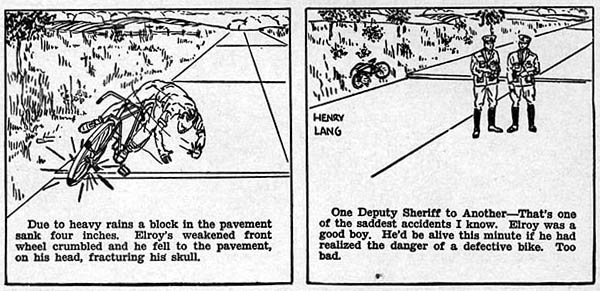
 Ride next to trolley tracks: fractured skull
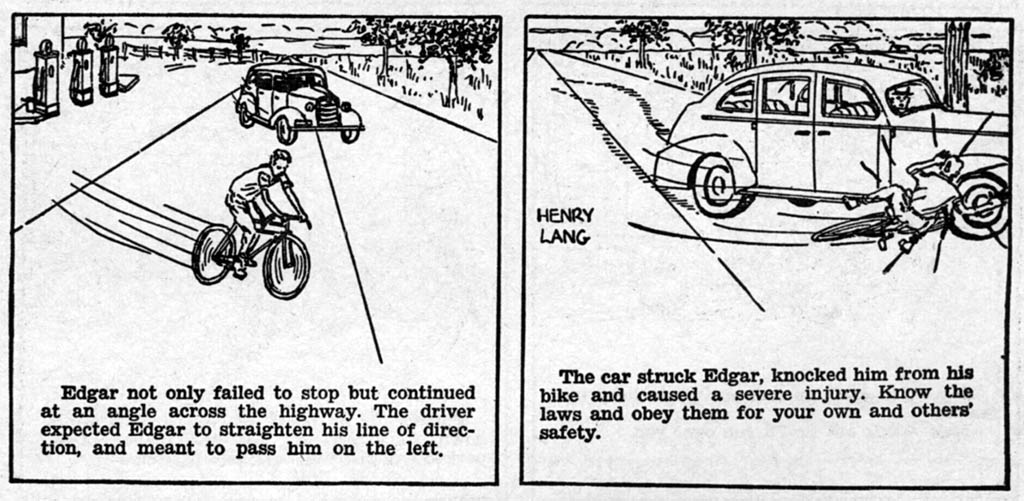
 Fail to stop: severe injury
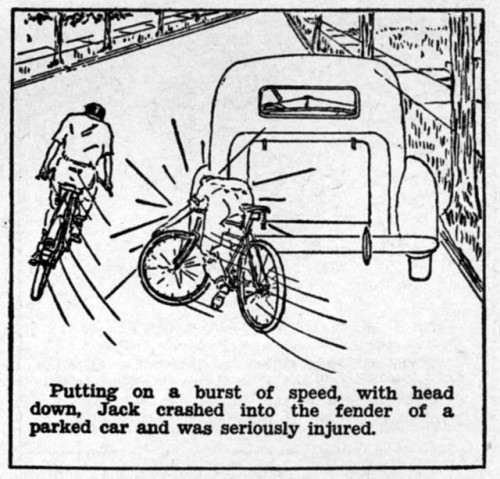
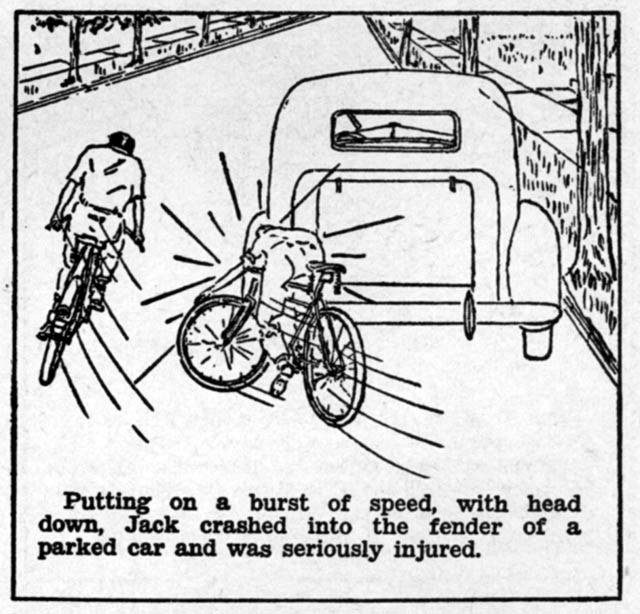
Racing with head down: seriously injured
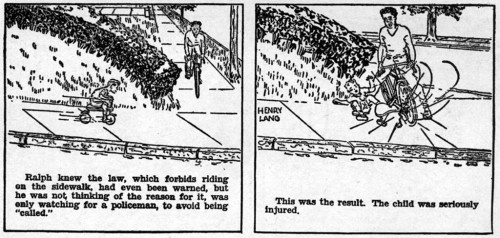
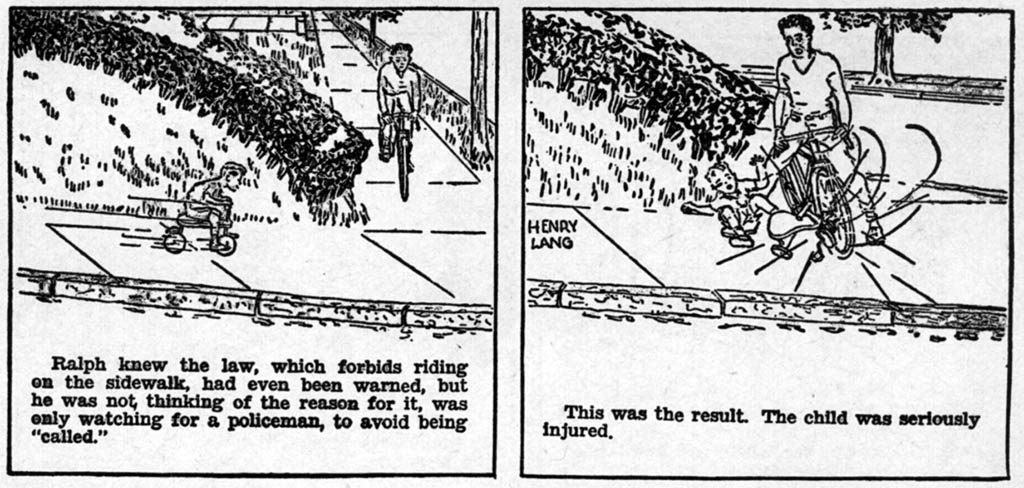
 Ride on the sidewalk: seriously injure a child
 Failure to stop: die on way to hospital
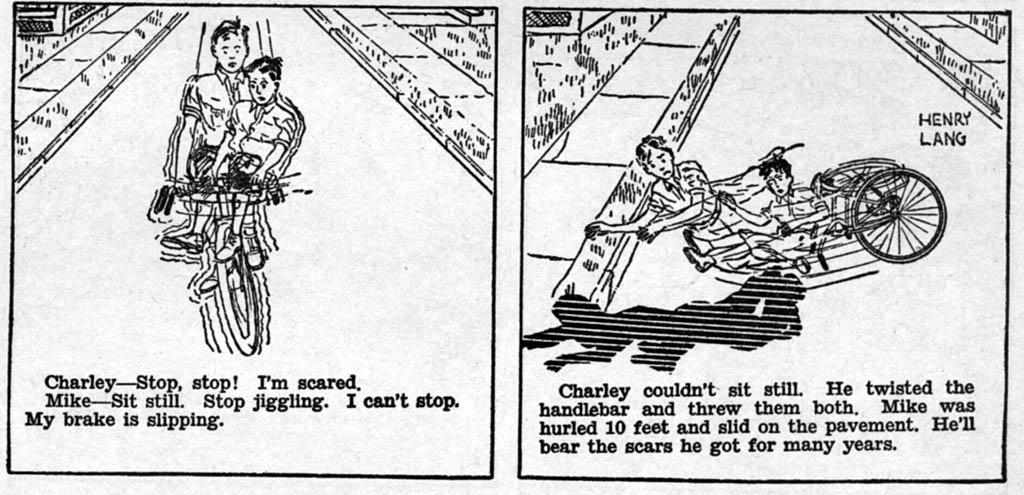
Ride on handlebars: scarred for years
Train for Century: break your bike, go to hospital
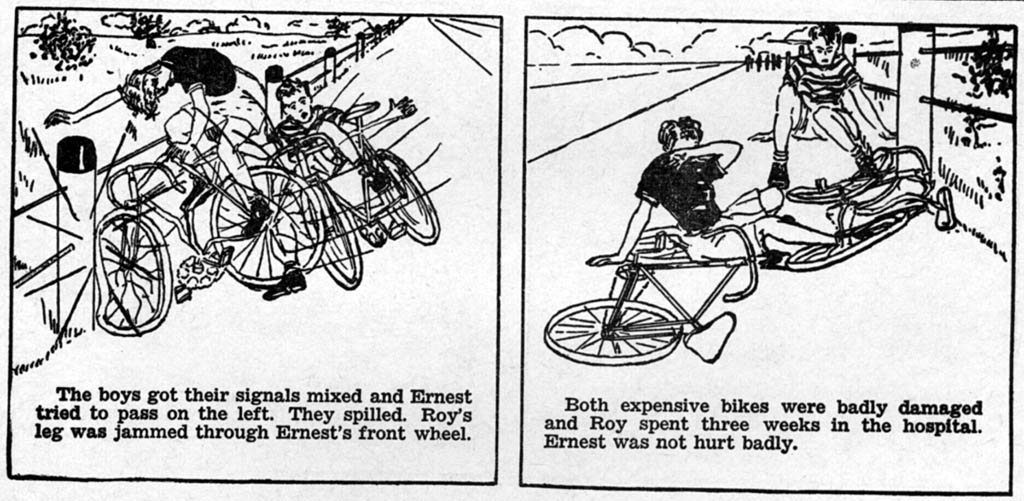 These boys were training for a 100-mile ride between Chicago and Milwaukee when they got their signals crossed and crashed into each other. The editor was obviously disappointed to note, “The riders were not violating any city ordinance because they were outside of the city limits. The editor fails to find anything pertaining to participation of bicycle riders in races or endurance contests. On the contrary, these boys were not racing but were training on a highway; however, their act is a dangerous practice.”
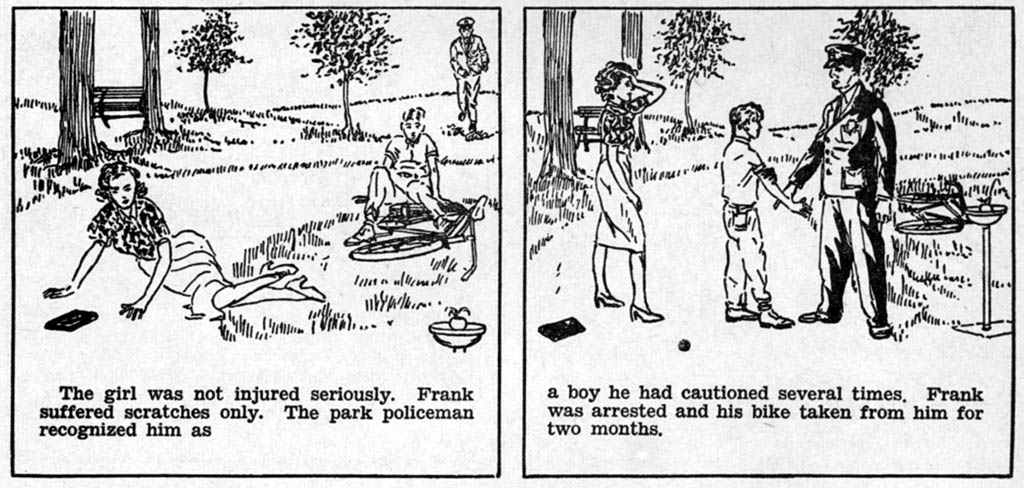
Ride on park path: arrested, bike impounded
Don’t maintain your bike: die
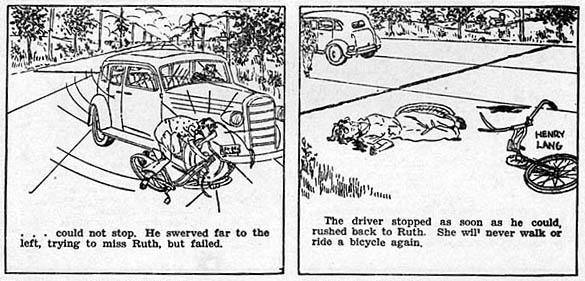
Think about your boyfriend: never walk or ride a bike again
Here’s where you can find the whole booklet
Here’s a link to the whole booklet as a gallery so you can see the “rest of the story” that lead up to these horrible consequences.
There’s an excellent chart of bicycle parts and some very detailed pen-and-ink cartoons that are fun to look at. Overall, the publication makes some good safety points.
Did people really think “Duck and Cover” would save them in an atomic war? We all should have been born turtles.
Jim,
We took that stuff seriously. Dad built a cupboard in the basement where we stocked up on canned goods and the like. Since he was a contractor, he always said that if it looked like it was REALLY looking bad, he’d bring home a dozer and bank dirt up around the house.
I don’t know if anybody I went to school with had an actual fallout shelter, but there were lots of CD placards around.
I volunteered to work at the local Civil Defense office putting together information packets and I carried a transistor radio on my paper route to keep up with what was happening during the Cuban Missile Crisis.
A few years later, a cop reporter I worked with told me he had been on one of the Navy ships that would have boarded the Russian freighters if they hadn’t turned back.
Here’s where I put cold water on Cape Girardeau’s plan to use a rock quarry as a fallout shelter:
http://www.palmbeachbiketours.com/capes-fort-d-gets-a-d-minus/
We had MIRVs and the best we could come up with for Civil Defense was a cartoon turtle?
Why am I not surprised.
We now have too much carbon dioxide and we come up with oil wars. And we don’t even get the oil.
Imagine how good it is going to be when the New York Times finally folds.
Love the bike safety cartoons. They’d never be published today for fear all the blunt talk about death and punishment would hurt tender young feelings or something.
Jim: I grew up in Miami and recall lots of stories during the Cuban Missile Crisis that included plans for how to dig a bomb shelter in your back yard and how to stock it. I’ve always wondered how many people actually did it.
George,
Anybody trying to dig a fallout shelter in Miami would hit water or rock before they were deep enough to do any good.
I’ll habe to digitize some of the old Civil Defense booklets one of these days.
In the late 1960s, when I was in high school, I volunteered with the local Civil Defense in my town in northern NJ. I remember we spent most of the time at our meetings calculating the nuclear fallout from various bomb blast locations based on wind speed and direction. In any scenario, we were toast. Also got to use cool things like dosimeters (pocket sized radiation detectors), Geiger counters and stuff. Also used to make the rounds of shelters to check on food and water supplies.
Art,
It was funny how you thought back in those days. Even though my hometown was the biggest one between St. Louis and Memphis, it had less than 25,000 people in it.
I heard conversations where people would try to0 come up with reasons why Cape Girardeau would qualify for Russian targeting: the Mississippi River bridge, the cement plant, the shoe factory….
Local pride is a strange animal.
The local newspaper once offered silver dollars to anyone who could prove that they had been missed in a Census counting. We were just under 25K. If we hit that magic number, we’d show up on road maps in larger type.
I’m glad to see that use of the word “moron” is not common usage, because people call me a moron all the time and I’d hate to think they meant something nefarious.
Those safety cartoons are great. Unfortunately, I was chuckling to myself thinking about them while riding my bike earlier today. Now I’m dead.
Dukibiddle,
That’s the way the herd gets thinned.
Sorry about that. (Who gets your bike?)
Amazing. The films we saw were more scary (I’m a little older) and the probably realized they were near to creating panic. I lived in the Kanawha (Chemical) Valley, home to lots of chemical plants, and we probably were targeted. The siren was right outside my first grade class, and they tested it without warning. I think we all had some hearing loss. The whole project was all dumb. If you were close enough to duck and cover, the radiation would get you within days, if you were lucky, or longer and slower.
Bob,
It was almost a matter of civic pride to come up with reasons why your tiny town would DESERVE a Commie nuke.
Well, we’re the biggest town between St. Louis and Memphis on the Mississippi River and we’ve got the shoe factory, the cement plant and the bridge across the river.
I wouldn’t be surprised to find out some day that the Chamber of Commerce sent the Russians Ten Reasons Why Cape Girardeau Should Be Considered for Nuclear Strike.
I mean, we wouldn’t want them to hit Sikeston or Perryville when we are so much more deserving.
The bicycle cartoons are good but need updating for todays kids, they will unfortunately just find them amusing.
happy earth day to you too Ken! I was thinking this morning before I read or saw your article about this time in our lives. Yesterday during a poetry workshop I was asked to imagine my school as a child and I have very vivid memories of the building. This morning I was thinking about it once again and how it just did not inspire poetry for me – but then I remember the duck and cover drills and how I have always thought that they started me down a road of unspoken of pervasive fear. It was a horrible thing to do to children.
After we moved to Melbourne, FL in 1964, I talked with many people who had grown up in the area, and their stories about the Cuban Missile Crisis when they were kids were chilling. At least they didn’t have to have the tornado drills that we also grew up with.