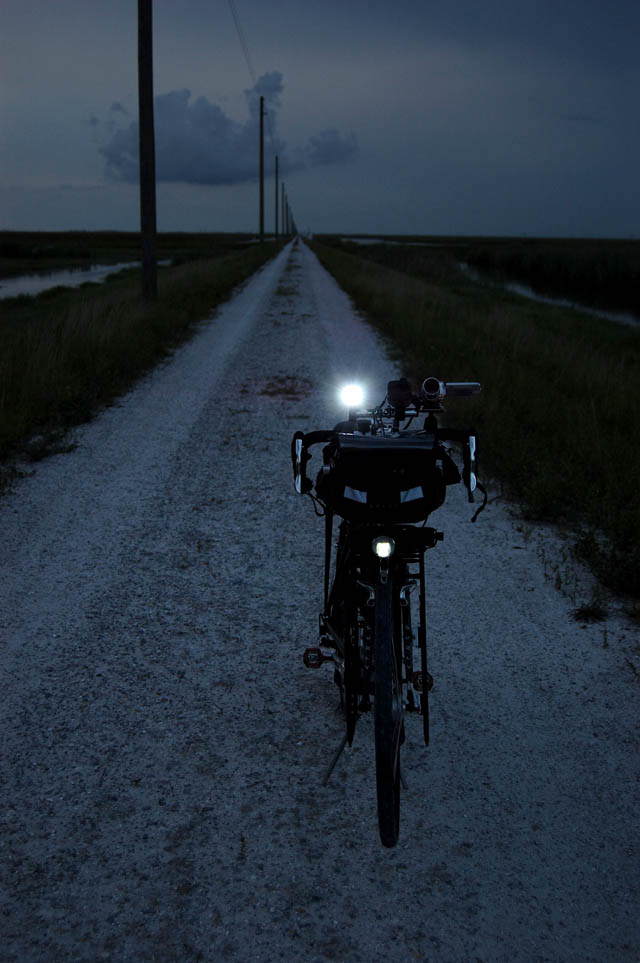
 I just bought a Busch & Muller Lumotec IQ Cyo R N Plus (hereafter referred to as the Cyo IQ) headlight in my eternal quest for the best and brightest light I can pair with my SON generator hub.
A review on one of my favorite bike blogs, EcoVelo, tipped me over the edge. Alan@echoVelo promised to write a letter to spouses because his endorsement generated lots of comments from folks like me who were going to reach for the plastic.
I’ve only had a chance to do one quick ride with it. Son Matt and I went out on shellrock roads in the middle of nowhere the other night, but we were hurrying back to beat mosquito o’clock and I didn’t have a chance to see it in complete darkness. I’ll post a full performance review later.
Here’s an overview of the light and how to install it in this review.
One Cyo IQ will replace two lights
I’ve used three generator-powered headlights with my SON.
(SON, by the way, has no relationship to Son Matt or Son Adam. It stands for Schmidt’s Original Nabendynamo. That mouthful is why most folks call it a SON.)
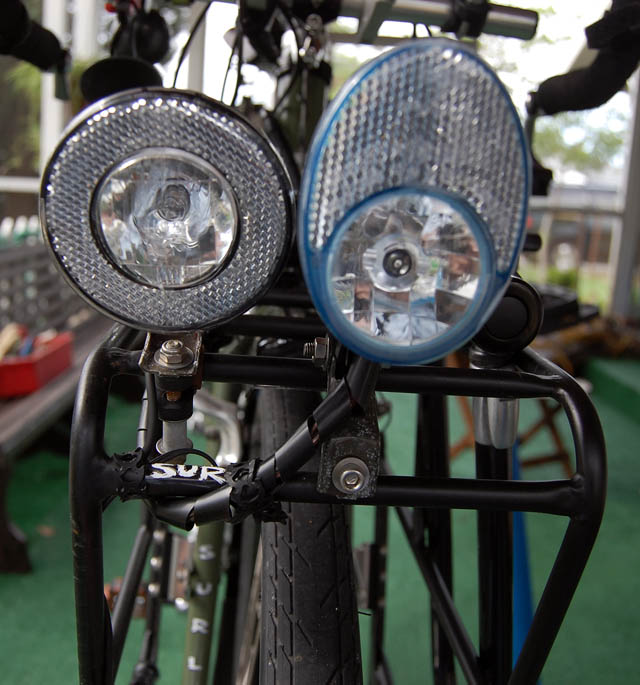 I started out with a Lumotec Oval Plus halogen bulb light as the primary, with a Busch & Müller Lumotec as a secondary.
The primary light would get up to full power at about 10 mph, and the secondary would be at full brightness at around 14 mph. The bad thing is that halogen bulbs get progressively dimmer as they age and eventually burn out. You can’t get one of these bulbs at a 7-11 in the middle of nowhere.
DLumotec offered more light at lower speed
Then B&M introduced the DLumotec Oval N Plus, which used a 1-watt LED as a light source. It reached full power at slightly over walking speed, never dimmed down and was rated at 100,000 hours, so there was no reason to ever turn it off.
The old Missouri safety slogan, “Lights On for Safety” was drummed in my head at an early age, so I LIKE to ride with my lights on.
The LED light was powerful enough that I rarely switched on the secondary light unless I wanted to aim the LED light close to the bike and the secondary down the road.
If you hate to read, here’s a video of the Cyo IQ installation
What comes with the Cyo IQ?
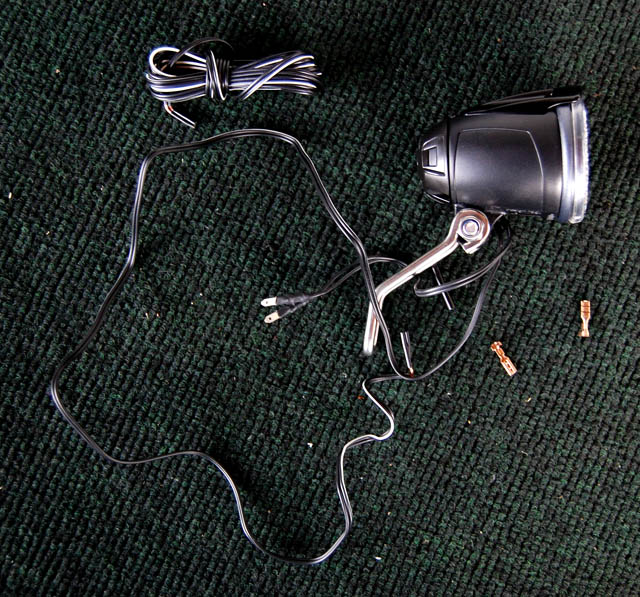 You get the light, with a bracket suitable for mounting to your fork; two female spade lugs (more about those later), a spare piece of wire and a couple of pieces of heatshrink tubing and a multi-language instruction sheet.
Coming out of the end of the light are two sets of wires.
- A short pair with two male spade lug attachments.
- A longer wire with no connectors.
The Cyo IQ R N Plus light comes in different flavors
The N designator means that it has a straight On/Off switch. A Senso version comes on automatically. Since I run with it on all the time, that didn’t appeal to me.
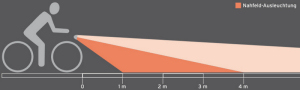 The R means it has a reflector, which is required in Germany, where it’s made. The R models are set up so that the “nearfield” is lit, something that is useful for low-speed commuters and loaded tourists. The standard model projects a brighter, more focused beam farther out for folks who go fast.
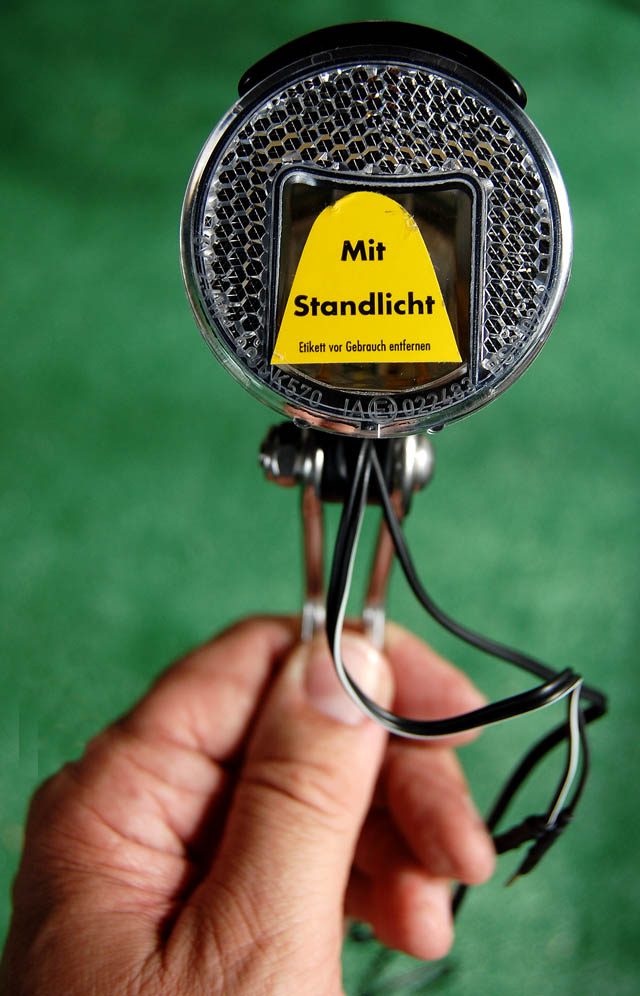 Both of them have a sharp cut-off at the top of the beam pattern to keep from blinding oncoming traffic, just like your car headlight. Peter White’s site does a great job of comparing light outputs.
The Plus means that it has a standlight. A capacitor stores enough energy from just a few minutes of pedaling so the light will stay on when you’re stopped. That means your light doesn’t go out when you’re at a traffic light.
I mounted it on my Surly Nice Rack
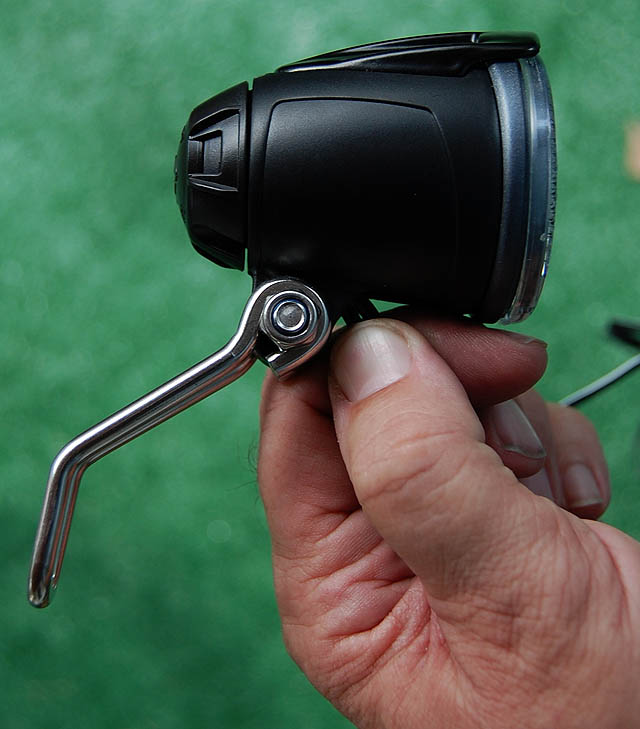 The light is designed to mount on the fork crown, so it’s shipped in a forward-leaning position to give clearance. I opted to mount it on the front of my Surly Nice Rack, where that would have had it sticking way out in front, vulnerable to being knocked about.
I reversed the mount, which allowed it to sit back where it’ll be less likely to be hit.
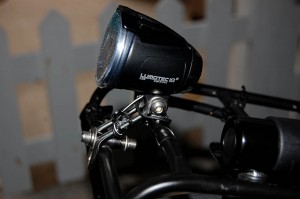 I’m very pleased with how neatly put together and compact the unit is. I had some issues with the dLumotec switch being a bit finicky sometimes. The On / Off switch on this light seemed to be much more positive. (Of course, in my case it’s really just an ON switch.)
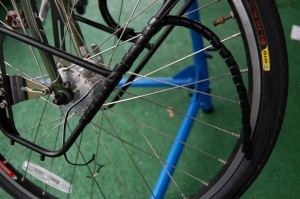 Plastic split tubing protects the wiring
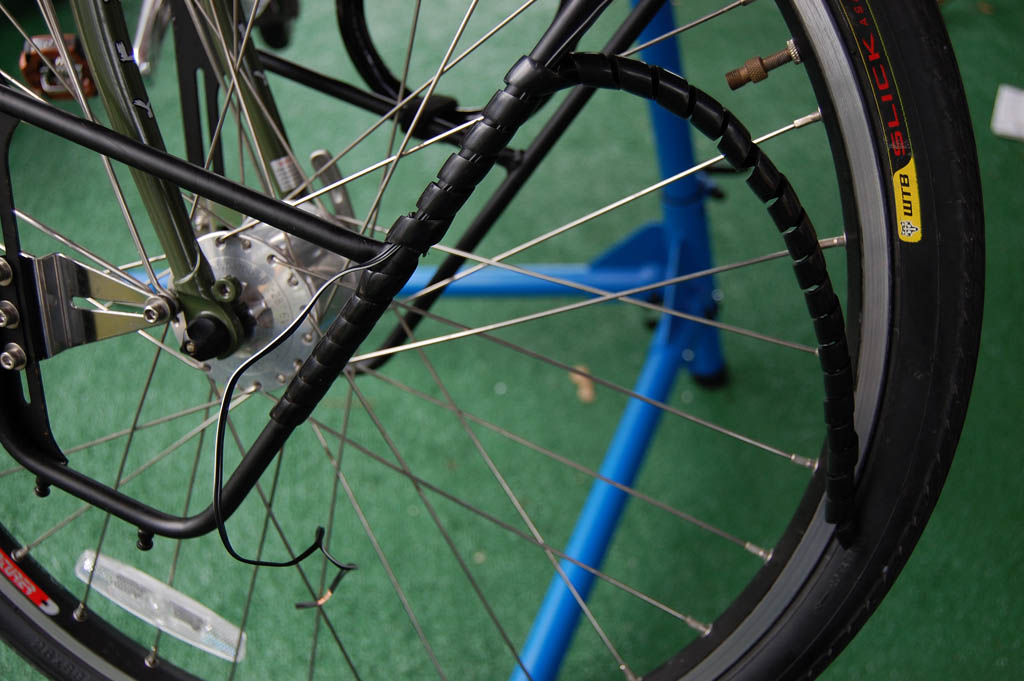
I used plastic 3/8″ spiral cable wrap or split tubing to run the wiring down the rack and to protect it. You can pick it up at Radio Shack or on Amazon.
It’s quick to apply, holds well and blends in with the black rack so it’s hardly noticeable. I like it better than black electrical tape which can turn into a gummy mess if you ever have to deal with the wiring in the future.
What about those terminals?
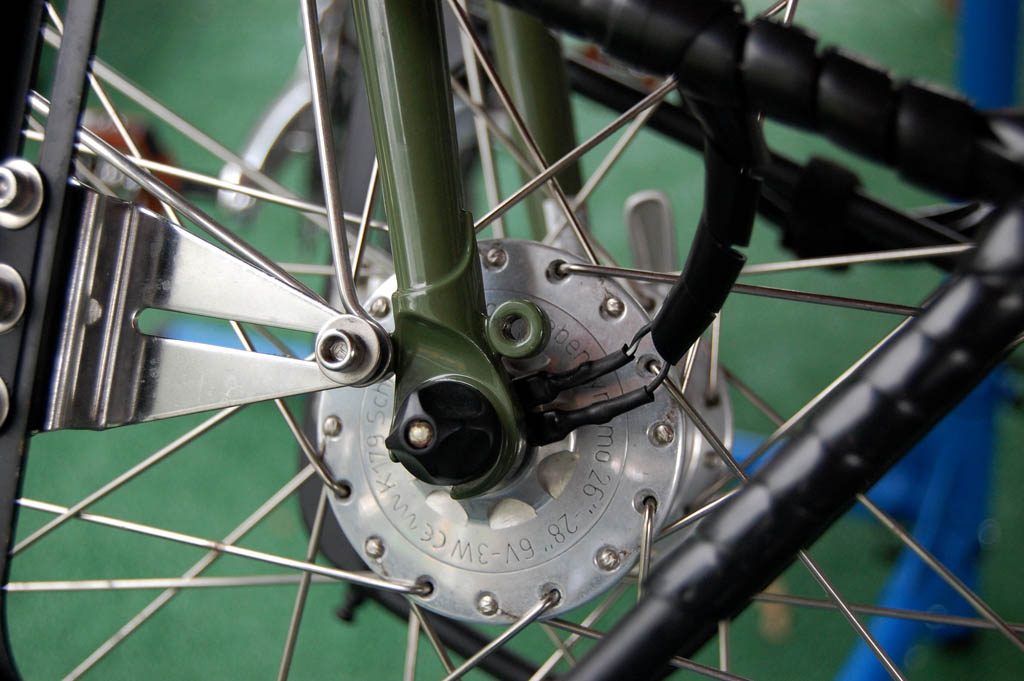 I have one major nit to pick.
The light came with two small female spade lugs to go onto the end of the wires leading to the hub. I’m a belt-and-suspenders kind of guy, so I carefully soldered the lug in addition to crimping them. You can’t beat both a good electrical AND mechanical connection. Then I put heatshrink tubing over THAT.
Then, and only then, did I look closely at the male connection points on the hub.
Think Great Dane mating with a Chihuahua. It ain’t gonna happen. Or, even if it’s possible, it’s gonna require some serious bending and stretching.
On top of that, they’re some funky metric size.
Instead of chasing all over trying to find new terminals, I opted to reuse the ones off my old light. I didn’t really want to do that, but it was the easiest and fastest solution to get on the road.
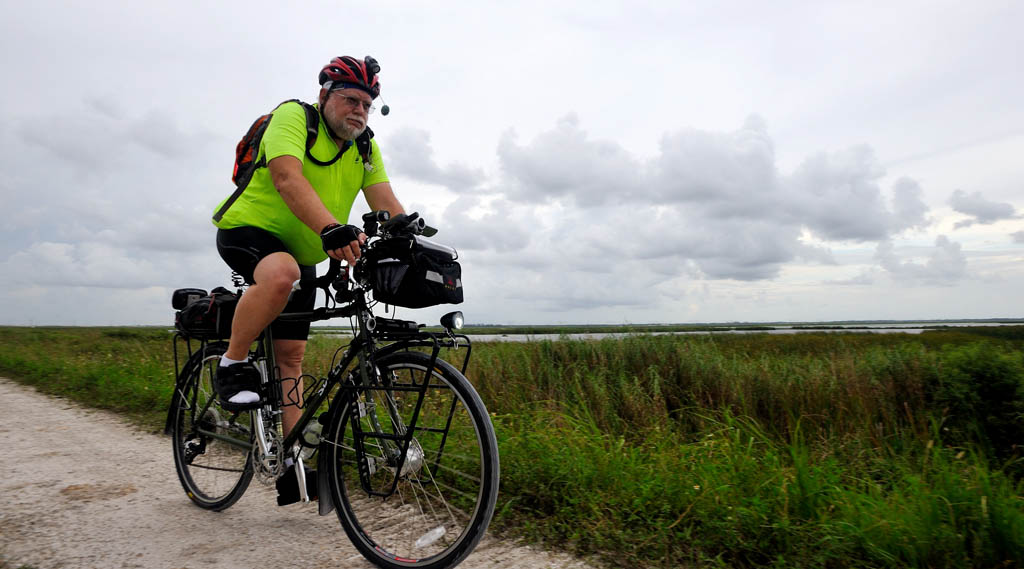
Son Matt shot this on the light’s inaugural run. For the record, I don’t usually wear white socks with my Shimano sandals. We were going to Bug Country at dusk and I wanted to be prepared to cover as many gnawable areas as possible as quickly as possible.
Where can I buy a Lumotec IQ light?
Alan, at EcoVelo, got his review light from The Bicycle Business in Sacramento, CA, so I decided to throw them some business, even though I usually buy this kind of thing from Peter White.
My only complaint – and it’s my fault for not looking at a map – is that California is a L-O-N-G way from Florida if you’re shipping by ground. I placed my order on Monday evening, August 17, it was shipped by Bicycle Business the next day, but didn’t arrive in South Florida until Monday, August 24.
I may stick with East Coast vendors in the future, not because I’m unhappy with Bicycle Business or manager Bob Rolke, but because I can get faster shipping from companies on this side of the Mississippi.
The light cost $103.95 plus $11.23 shipping.
I’ll have another review when I’ve logged some nighttime hours.
Looks like a nice light. I’m debating on the generator hub route, but it’s so darned expensive. It would be nice not to have to worry about carrying spare AAA’s around with me though.
Nice review, Ken!
Two curiosities:
1. You mentioned an old Missouri saying. Are you from MO?
2. Have you considered the Edelux light? If you did, why did you choose the one you chose over the Edelux? I am considering the Edelux and hence the question!
Safe rides to you!
Peace :)
-Chandra…
Todd,
I asked Wayne at my LBS how many generators he’s sold.
“About eight in two years.”
“Who buys them?”
“Guys like us who want to be able to ride our bikes anytime we want, for as long as we want and who can do math. I had a guy come in whose commute ends after dark half the year.
“He calculated how many batteries he burned through in a year and figured his pay-off would be less than six months.”
If you argue that you’ll use rechargeables, so that’s not a factor, I’ll ask you how many times you’ve forgotten to charge your battery, how many times you’ve wonder “is my battery charged?” or how many times you’re on a multi-day trip where you can’t charge the battery.
I have and love a NiteRider Pro-12E. It’s siting on the shelf because the battery – the third one – is dead. I’ve spent more money on replacement batteries than my SON hub cost.
A generator is something that pays for itself in the long run if you’re someone who rides in the dark. You have light as long as you have legs.
Chandra,
Yep. Cape Girardeau, MO. My dad was a road builder, so I lived in a whole bunch of little MO towns until I started school. Cape was always home, though.
I picked the Lumotec because of Alan’s review. I had read about a lot of the new LED lights and had been tempted, but his review put me over the edge and it hit a price I could (almost) afford.
But, no, I didn’t do a careful analysis of everything that’s out there. If you haven’t been to Peter White’s site, follow one of the links in the review. He’s got some good comparisons.
G’day
Great write-up as always Ken. I will be interested in your performance updates down the road. I am pretty keen to put a SON and light on my Surly LHT down the track because of the winter commuting.
Thanks
Andrew
Andrew,
I did a short ride tonight right at dusk. The difference is substantial in the good direction. I need to tweak my aim just a little bit more, but I was impressed at the amount of light it put on the street.
I did a video last week of a ride with my old lights. Sometime in the next few days I’ll ride the route again and post a comparison.
You won’t regret getting the SON with the kind of commute you do.
Hi Ken,
I lived in St. Louis for about 11 years until I moved to TX last year. I will check PWC for the light comparison. Thanks.
Peace :)
-Chandra…
Andrew asked me on another forum what was the actual problem with the connections to the terminal.
I should have been more clear on that.
The female spade connectors that were shipped with the light were way too small to fit over the male terminals on the hub.
They were the size to mate with the taillight.
They are also a funky metric size that you don’t find in normal hardware stores. Peter White sells them, but I didn’t want to wait to get them from him.
I HAVE managed to make do with some non-metric ones in the past with some judicious crimping, but I decided to reuse the ones off my old light in this case.
I’ve been waiting for something like this — both the light and the reviews. Thanks for both this post, and the link to the original. This might be the year I switch to a generator hub. Days are getting shorter.
Dad (Ken of PBBT fame) gave me a generator hub for my Trek commuter bike a couple years ago along with his hand-me-down DLumotec Oval N Plus headlight. I did have to purchase my own generator-powered tail light.
Long story short, generator is the way to go. I, too, had a Niterider 12E and replaced the very expensive battery twice. Still, the run time was never long enough and it never seemed to be fully charged when I wanted to use it.
The generator always works. I’ve cycled 2,000 miles this year and have never once thought about batteries. I get on my bike and go.
I’m sure some generators are better than others. I’m sure some lights are better than others. Do your research to figure out which is which. Still, I’d rather have a middle-of-the-road generator light set than anything that requires charging or throw-away batteries.
Screw the environmental concerns of throw-away batteries, I’m just lazy and want the convenience of a generator.
Cheers,
Matt
Nice one, Ken. I’m glad to hear the light is working out for you so far. I’m looking forward to reading your follow-up report.
Wow, great instructions! I’m tempted to buy an awesome light like this, but the city never really gets dark enough to make it worth it. :)
Dottie,
Where do you live?
I’m assuming (hoping) that you are using a be-seen light, even if you don’t need the light to see the road.
Hey, Ken. I know you are always looking for new ways to be seen on the road. Don’t know if you’ve seen this tail light before. Sadly it’s battery operated, but if the picture is accurate this is one seriously bright tail light.
http://www.longleafbicycles.com/products/dynohubs-and-lighting/battery-tailights/dinotte-tailight/
Todd,
A buddy has one and I’ve ridden behind them before. They are PAINFULLY bright, almost to the point of being overkill (and when I say that, you KNOW that it’s bright).
I’m not crazy about paying that much and I’m not crazy about their mounting system.
Still, if I found one under the Christmas tree, I wouldn’t make Santa come down the chimney to take it back.
Thanks for the info Ken. I’m thinking of getting one of these lights because over here in Great Britain I do most of my riding in the wind, rain and dark in the winter. One question. If you’re soldering the wires to the contacts on the hub what happens when you get a puncture 10 miles from home?
Graham,
I solder the wires to female terminals that slide over make terminals on the hub. If you have to remove the wheel, then you just slide the terminals off.
That’s the main reason I solder the wires and cover that joint with heat shrink tubing. If someone gets careless and yanks on the wires instead of grabbing the terminal, I don’t want the wires to pull out?
Did that answer your question or confuse you more?
You won’t regret the light nor the hub. It’s truly install and forget it.
Nice write up, Ken. Glad to have stumbled across your website.
To address one question above–the only difference between the Cyo and the Edelux is that the Edelux has a more effective heatsink since the whole body is aluminum. The led emitter and optics are identical to the Cyo non-R version (the R version has slightly different optics to focus some light directly in front of the bike). The Cyo’s body is plastic, except for the metal hood at the top of the light that acts as a heatsink. This is a less effective heatsink than the Edelux, so the Edelux–although otherwise identical–runs a little bit brighter than the Cyo. Not much, and not enought to justify the considerable extra cost in my opinion if your only concern is illumination. The Edelux is much prettier, though, which is sometimes worth the extra money. I sell about ten Cyo’s for every Edelux, so most customers agree.
I carry the Cyo R and non-R lights as well as a lot of other dynohubs and genrator powered lights. I’m in Wilmington, NC and ground shipping is two days to Florida.
Happy Touring,
Anthony King
Longleaf Bicycles
I recently ordered a Cyo and tail light combo (and a 650b wheelset with Shimano dyno hub) from Longleaf. Good stuff. Sadly I haven’t had a chance to finish building that bike yet.
Anthony,
Thanks for the info and clarification. I’m glad I went for the less expensive option if the difference is mostly aesthetics.
I’m into function over form.
Looks like Todd BS is giving your shop an endorsement. Nice to have options.
Ken
Great run down and the video just clinches it! Thanks! No LBS in Singapore has any experience in wiring up a dynamo light any more (or could be bothered by it) So I was getting a bit concerned that I might have to do a first time trial and error. Your blog and video helps heaps.
I’m waiting for my hub dynamo to arrive and was wondering about the light. Looking at the overall comments on the net, I’ll go for the Cyo over the Fly.
Just wondering … I’m thinking of combining the B&M E-Werk with the light, and maybe still have a dynamo taillamp. Would you or anyone you know have tried this?
Cheers
theodore
Theodore,
Glad it helped. It’s really not hard. The main thing is to make sure you get the right size terminals to fit the lugs on the hub.
I run a generator taillight, in addition to other lights. You can see my old setup on my Trek 1220 here. I moved the same lights over to my Surly, but I’ve quit using the NiteRider because the battery got tired and I didn’t want to spend the money to replace it.
http://www.palmbeachbiketours.com/bicycle-taillights-that-work/
Here’s another look at my bike after dark.
http://www.palmbeachbiketours.com/glo-gloves-add-safety-to-night-riding/
If you have any other questions, don’t hesitate to ask.
I should have noted that the steady red light in the Glo-Glove video is the generator light. It doesn’t flash.
Hi Ken, Nice work on the dynamo lights. im waiting for mySON28 hub to come in and am going to add a IQ Cyo N senso plus. I was wondering whether it would be possible to setup the cyo as a primary and a lumotec as a secondary?
Bren,
I could see only a marginal improvement when I used my Lumotec as a secondary with the Oval Plus. I would aim my primary a little closer, since it came on first. The secondary wouldn’t really get to full brightness at less than about 14 mph, so I had it pointed for distance.
I don’t think there would be any advantage of adding it to the IQ setup. You just don’t need it. The IQ throws out a lot of light, probably enough that it would outshine the secondary.
As far as to whether or not it’ll work, I’m not sure. Go to Peter White’s site
http://peterwhitecycles.com/schmidt-headlights.asp and search down to the section he calls “Primary? Secondary? Huh?” Maybe you can make more sense out of it than I can.
It sounds like you can’t marry the two: “The Lumotec IQ Fly headlights cannot be used with the E6 Secondary headlight.”
When in doubt, send him a message for clarification.
Hello, I have a lumotec iQ cyo n plus, it is supposed to be used with a dynamo hub, however I have a 6V 3W bottle dynamo. Is it possible to use it with a bottle dynamo? What’s the difference? does the dynamo hub produce a differente voltage? what would happen if I use it? would it be less bright than with the hub?
Hello, I have a lumotec iQ cyo n plus, it is supposed to be used with a dynamo hub, however I have a 6V 3W bottle dynamo. Is it possible to use it with a bottle dynamo? What’s the difference? does the dynamo hub produce a differente voltage? what would happen if I use it? would it be less bright than with the hub?
Thanks in advance for any comments.
Carolos,
I can’t answer your question, but I’m going to hazard a guess that volts is volts and that it should work.
Drop a note to Peter White, who is one of the main distributors of dynamo lights and generators in the U.S.
He’s at pjw@peterwhitecycles.com or call him at 603 478 0900 (the call is probably better).
Thanks Ken, before I saw your answer I had written directly to the manufacturer. He tells me that the light
can be used also with a 6V bottle dynamo, it is just that it has a switch to be turned off that I won’t be using, which will be very useful whenever I feel like upgrading to a hub dynamo. Happy holidays!
Ken,
I just installed an IQ Cyo and a Seculite Plus tail-light and it occurred to me that there may be confusion about the B&M female connector that is supplied with the light.
The female connectors supplied are fact for the wiring to the REAR light. They fit on the Cyo’s second (short) pair of flyleads that come ready fitted with male connectors. Similar male connectors are found on the Seculite rear light.
Im seriously considering a dynamo for winter as its approaching fast. I also have a nice rack and am intrested in the lumotec cyo iq. I love the way youve mounted youres. But where youve mounted it on the i rack i always get a flow of crud decorating that area. Would this constant shower effect the light?
Jason,
I haven’t noticed any crud on the light. I DO have fenders front and rear, so any spray is directed downwards.
I’ll pick up some bugs on the lens from time to time, but you’d get those no matter where the light was mounted.
Hope these are easy to install. My dad is going to start bike riding in the evenings and with it coming up to winter I really would prefer if he had a light or something like thisto attach to his bike as it will start to get dark much earlier soon.
Thank you for providing the vast amount of information about the Cyo IQ. I am a slow rider and my commute requires me to be out early during dark mornings. This light is perfect for me! I purchased one to replace the dull dynamo light that came standard on my Dutch bicycle.
bicyclemamy,
You won’t regret it. It throws out just the right amount of light and it comes on full power at low speeds.
Uh. The problem is the Shimano hub is supposed to come with a small connector/plug. Does’nt, for some reason.
Given the need to take front wheel out for flats, shipping, etc, the plug sesm like a better option.
Where to get?
Well, Peter White, eg. Nexus Generator Connector plug.
Ken what about that awsome pulsating tail light you got at amazon. Can you tell us the name of it?
thanks,
k
I am closing comments on this topic for a time. It has become popular with spammers.